


👋 Hi, I’m James. I write Building Momentum to help you accelerate B2B SaaS growth through product marketing, GTM strategy, sales, and marketing.
Are you an ambitious product marketer - but want to get the tools, skills, and confidence to accelerate your career?
Join us for the next live cohort of GTM Playbook starting May 7th.

Somewhere in the last 12 months, a marketer at a B2B software company saw “agentic AI” trending.
Maybe it was a LinkedIn post from a VC. Maybe an analyst report landed in their inbox. Maybe their CEO forwarded an article with “we need to be talking about this.”
So they did what marketers do: they added it to the website.
Now the hero says “Agentic procurement software.”
The product page talks about “agentic workflows.”
The sales deck has a slide explaining what “agentic” means.
But… pipeline hasn’t moved.
I’ve seen this pattern play out across dozens of companies… and not just with “agentic”, but with every technology buzzword that’s come before it.
The instinct to chase trends is understandable. The problem is that trend-chasing and buyer conversion are fundamentally opposed.
I’ve looked at dozens of B2B SaaS websites this year so far. There’s an epidemic happening in AI marketing right now, and it’s costing companies conversions they’ll never see in their CRM.
Everywhere I look:
“Agentic procurement software”
“Agentic marketing automation”
“Agentic data quality platform”
“AI-native workflow orchestration”
“Autonomous operations intelligence”
It sounds cutting-edge [to you].
But to a buyer with budget, authority, and a problem to solve? It’s noise. Or worse - it’s a signal that you’re not for them.
Your hero has one job
Every visitor who lands on your homepage asks the same question in the first three seconds.
“Is this for me?”
Not: “Do I understand what agentic means?”
Not: “Is this technically impressive?”
Not: “Do I grasp the underlying AI architecture?”
Just: “Is this for me?”
If the answer isn’t immediately obvious, they’re gone. Back to Google, on to your competitor, to an alternative solution that isn’t you.
Your website hero isn’t a place to show off your technology vocabulary. It’s not a signal to investors that you’re on the AI train.
Your website hero is a filter. And “agentic” fails the test for 99% of buyers.
Why marketers chase trends
When a new term starts trending, marketers feel pressure from multiple directions:
Fear of being left behind. Your competitor just updated their website to say “AI-native.” Your CEO saw it. Now there’s a Slack message asking why we don’t have that.
The category land-grab instinct. If “agentic” is going to be the next big category, you want to be seen as a leader in it early. First-mover advantage, category creation, and all that.
Signalling to investors and analysts. If VCs are excited about agentic AI, and you’re raising or thinking about raising, you want that language visible.
Internal pressure to look current. Nobody wants to be the marketing team that “missed” a trend. It feels safer to adopt the language than to explain why you haven’t.
All of these pressures are real, but all of them optimise for audiences that aren’t your buyer.
Every technology wave brings a jargon surge, and every jargon surge creates the same mistake. We had cloud, big data, SoLoMo, clicks-and-mortar, headless. Now: agentic, autonomous, AI-native.
The mistake is assuming the technology term is the value proposition, and that naming the mechanism has the same impact as naming the outcome.
The thinking goes like this:
The product team ships something genuinely impressive: an AI system that can make decisions, take actions, operate with less human oversight.
Then someone says: “We need to communicate this on the website.”
Instead of translating the technology into buyer outcomes, they just... name the technology.
“Agentic” goes in the hero. Job done.
Except it isn’t done. because buyers don’t care about your technology. They care about their problem.
The audience mismatch
The people searching “agentic AI” right now aren’t buyers with problems they are willing to pay to solve.
They’re marketers trying to understand if they should use the term.
Analysts writing reports.
Journalists covering the trend.
VCs pattern-matching for their next investment thesis.
Industry interest isn’t buyer intent.
Your actual buyer - the VP of Procurement drowning in rogue spending, the Head of Marketing buried in manual campaign work, the RevOps leader dealing with data quality - isn’t Googling “agentic [solution].”
They’re searching for their problem, in their words. Or they’re not searching at all - they’re getting a referral, clicking a link from a colleague, landing on your site from an ad.
And when they land, they have one question: “Is this for me?”
“Agentic procurement software” as your H1 doesn’t answer that question. It creates a new one: “What does agentic mean?”
It’s unnecessary friction that kills conversion.
Think about how your buyer actually moves
They’re not sitting in a quiet room, ready to learn about AI architectures.
They’re scanning your website. They’re distracted, comparing you to five other tabs they opened from the same Google search, wondering which 3 vendors they should begin evaluating.
If your hero says “Agentic procurement software”, here’s what the buyer hears:
“This is probably a tool for technical people. I don’t know what agentic means. This feels complicated.”
And they click away.
You have three seconds to resonate with them, and instead you just got a silent bounce.
Now imagine your hero says: “Stop rogue spending before it happens.”
It can be the same technology underneath, the same innovation, the same benefits and outcome. But now the buyer hears:
“Wait, that’s my problem. We have procurement spending issues. I want to prevent it. This can solve it automatically. Let me read more.”
That’s the recognition moment: what your hero is supposed to create.
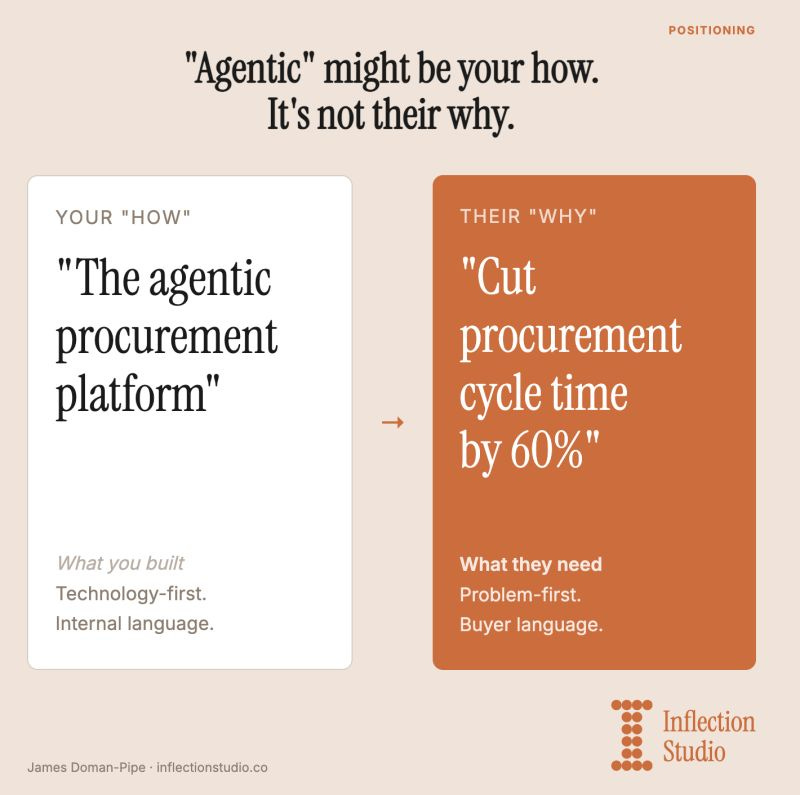
“Agentic” is your how, not their why
“Agentic” describes how your product works: the technical capability that makes it different from dumber software.
But your buyer doesn’t care about how - at least not in the first few seconds.
They care about why they should pay attention right now.
Their why is:
“I’m spending 40 hours a week on procurement challenges that should take 40 minutes”
“My marketing team is drowning in manual campaign work”
“Our data quality issues are killing sales productivity”
“I can’t get visibility into what my team is actually doing”
Those are real problems with real consequences… Problems that someone with budget and authority is actively trying to solve.
“Agentic” is your answer to “how does this work?” - a question they’ll only ask after they believe you understand their problem.
Your hero needs to lead with the why. You then earn the right to explain the how, straight after.
The altitude problem
I’ve written before about the altitude problem in B2B positioning and sales narratives.
When you lead with technology terms, you’re flying at 30,000 feet talking about categories, capabilities, architectures. The air is thin and nobody has time.
Lofty, high-altitude messaging is a tax on your marketing and sales effectiveness.
Because buyers live at ground level, in their inbox, in a failing process, and in a conversation with their CFO about why this project is taking so long.
Your hero needs to meet them there.
“Agentic” is high-altitude language, at a level level the buyer hasn’t reached yet - and might never reach if you don’t give them a reason to care first.
Ground-level language sounds like:
“Cut procurement cycle time from weeks to hours”
“Stop campaign bottlenecks before they slow you down”
“Get clean data without the manual work”
Same technology. Different altitude. Dramatically different conversion rate.
But our investors want to see “AI”!
“We need to signal that we’re an AI company. Investors are looking for AI. The market rewards AI positioning!”
Fine; but there’s a difference between signalling AI and making it the centrepiece of your value proposition. There’s a difference between your investor narrative and your sales narrative - they SHOULD be different by design.
You can absolutely say you use AI. You can have an “AI-powered” badge. You can explain the agentic architecture on your product page, in your sales deck, in your investor materials.
But your homepage is optimised for investor signalling instead of buyer conversion, you’re making an expensive trade-off that’s not going to translate into pipeline. And as we all know, pipeline traction matters more to investors than what’s on the website homepage.
The exception: when trend language is buyer language
Of course, there are always caveat. There are buyers out there whose literal mandate is "find agentic AI solutions."
Maybe they’re at tech-forward companies, running AI or innovation teams, or the CEO read the same analyst report, and now they've been told to go evaluate vendors in this space. For them, "agentic" isn't jargon - it's the search term. It's the frame they're using to make sense of the market and make their decision. They’re hopping on the trend because it’s trendy.
If you’re confident that early-adopter, innovation-focused buyers are your primary market - and that chasing them will deliver the pipeline you need - then the trend language might be exactly right.
But I’d hazard that most B2B SaaS companies aren't selling to buyers at the cutting edge of innovation. They're selling to functional buyers with operational problems. Those buyers don't care about "agentic." They care about getting their time/money/life back.
If you're using "agentic" because it sounds cutting-edge, or because your competitors are using it, or because you're worried about being left behind... you're probably optimizing for the wrong audience.
Start with the problem your buyer already has, in their words
Write down the three biggest problems your product solves
For each one, write how your buyer would describe it (not how your PM would describe it)
Validate it - listen to sales calls, interview prospects, search reddit or professional communities
Pick the one that’s most urgent, most painful, most recognisable
Put that in your hero
Let me give you a concrete example.
Before: “Agentic procurement software”
After: “Stop maverick spending before it happens”
After: “Cut procurement cycle time from weeks to hours”
After: “Finally get visibility into what your team is actually buying”
Same product, same AI, same agentic architecture underneath. But now the hero is a recognition moment for a buyer who has that problem.
Your technology - the agentic bit - still matters. It’s just sitting where it belongs: in the subhead sentence, in the “how it works” section… after you’ve earned their attention.
Go look at your website hero right now
Is it speaking at buyer altitude, or technology altitude?
Is it creating a recognition moment, or asking buyers to learn your vocabulary?
Is it answering “is this for me?” or answering “what technology did you build?”
If your hero contains “agentic,” “AI-native,” “autonomous,” or any other technology term that requires explanation... consider whether you’re optimizing for hype, or traction.
Your technology is how you solve it. It’s not why they should care.
Lead with the problem they already have, in their words.
What’s the worst buzzword-heavy hero you’ve seen recently? Reply with a screenshot - I’d love to feature the best (worst?) examples in a future post.