


👋 Hi, I’m James. I write Building Momentum to help you accelerate B2B SaaS growth through product marketing, GTM strategy, sales, and marketing.
Every go-to-market team has to figure out how to sell the future without lying about it.
That’s easy to say and hard to do.
The pace of building has exploded. AI-assisted engineering means teams can spin up new capabilities in days. But shipping isn’t the same as releasing. QA, pricing, enablement, and rollout still move on human time.
The result: a messy middle full of “almost ready” features and internal betas that the market doesn’t see yet, while buyers are actually judging you on where you’ll be next year.
They don’t just buy your product. Investors, partners, and customers are all buying your momentum.
I’ve learned the companies that win aren’t always the ones that build fastest, or the ones that build the best product. Instead, they’re the ones that make progress visible before anyone else believes it.
If you only sell what’s live, you undersell your potential.
If you only sell what’s next, you break trust.
The job is to sell the slope: to show what’s real today, and what’s becoming real.

Why buyers buy momentum, not just product
Sales needs something to sell. Product wants to wait until it’s stable. Marketing worries about over-promising. Success teams brace for support load when things launch, whether they’re stable or not.
… Ultimately, everyone is stuck in a different version of the truth.
Buyers, meanwhile, don’t care about those internal trade-offs.
They care about what they can see: progress, energy, direction.
You can build faster than ever, but if the market can’t feel that motion it might as well not exist.
Selling the slope isn’t a storytelling trick.. it’s a positioning strategy. You’re not educating the market on what you do today. You need to educate them on where you’re going.
The key to introducing something new is gradual motion, not sudden reinvention. Timing matters - too early, and it won’t land.
Selling the slope follows the same rhythm: invite people into your trajectory, one believable step at a time.
Examples: how to walk the line
Brainfish have got this down! Their homepage starts with a grounded, current value proposition: AI support that feels built-in, not bolted on. That’s the product as it exists today.
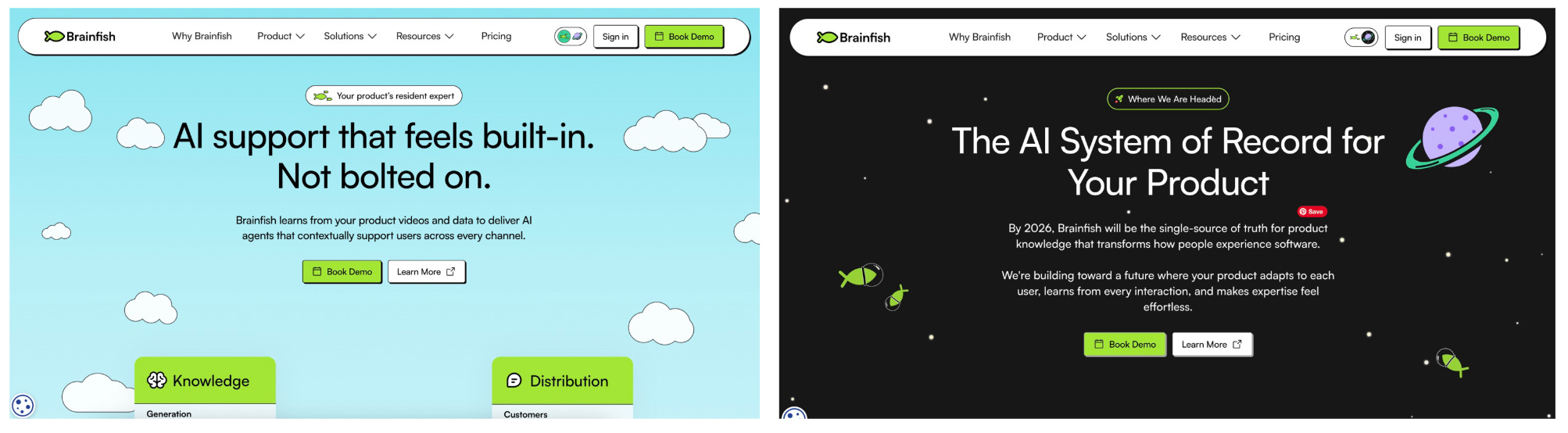
But, click the spaceship icon in the menu bar and boom: you get a great sense of their direction. No release dates. No buzzwords. Just a clear sense of motion.
That duality - today’s product and tomorrow’s intent - builds trust. The company feels alive.
Zendesk followed the same playbook over years. Their message shifted gradually: from support software to customer experience platform to AI-powered service suite. I wrote about this when I reviewed their positioning evolution: each repositioning wasn’t a reinvention, but a visible continuation of what came before.
Make the future visible, but believable
Selling the present feels safe. You can demo what’s live, point to proof, and stay factual, but it flattens your story.
Buyers don’t just want confidence in what exists, they want evidence of what’s evolving. Momentum should be part of your positioning. If you don’t project it, someone else will (and they’ll leapfrog you quickly).
The opposite is more dangerous. I’ve seen teams promise future features to close deals, demoing prototypes as if they were live, or showing slides full of intentions dressed up as products.
It works for a while… until it breaks.
Customers get frustrated when promises don’t materialize
Support teams drown in tickets
CSMs spend months resetting expectations
Reps lose confidence (and commission) when deals churn
I’ve written before about how to prepare sales to talk about what’s coming without slipping into speculation. The same discipline applies here: teach people how to sell intent, not illusion.

Align behind a shared statement of direction
Selling the slope only works when everyone tells the same story. That means alignment - and as a product marketer, it’s your job to connect the dots.
In multiple companies, I’ve built a shared Statement of Direction - a single slide deck that replaced the guessing game between product and sales. This becomes the living narrative: a way to align intent without over-committing to dates.
A good Statement of Direction isn’t a marketing deck. It’s a leadership artefact: the bridge between your vision narrative and your next two quarters of execution.
It’s what lets every investor update, sales call, and roadmap review tell the same believable story. It should describe your themes, goals, and intended outcomes. Not dates or specs, just direction. It should answer:
What’s live now
What’s in motion
What’s being explored
Then teach sellers and CSMs how to navigate the grey area. Give them phrases and connective tissue that express confidence without over-promising - things like:
“In pilot with early customers”
“Scheduled for validation later this quarter”
“Under active research for next year”
Build those distinctions into decks, product pages, and demos so everyone stays consistent.
Finally, make it tangible. Give sellers something they can show: Figma prototypes and visual mockups. Invite product managers into key customer conversations to help shape that story live.
When all of this aligns, the future stops feeling abstract.
Don’t forget pricing, rollout, and the reality of your business
Selling the slope doesn’t stop at messaging… it ripples through pricing, rollout, and support.
If new products or modules are coming, customers should have a sense of how pricing might evolve. Springing a new tier or upsell later creates sticker shock. See if you can agree pricing guidelines like:
Significant new products will be charged separately
New features may be chargeable as an add-on
Beta testers will receive 6 months free and a 50% 1 year discount from market rate if they decide to continue
Customer success needs the same preparation. They should know what’s on the horizon so they can manage adoption, renewals, and education.
Ultimately, the roadmap and the story and the future is business strategy challenge, not just a product marketing/product management thing.
Keep your slope alive: turn momentum into a rhythm
Selling the slope is a rhythm, not a one-off campaign.
If you talk too far ahead, it becomes fiction
If you’re too vague, it loses meaning
If teams tell different stories, you fracture trust
Keep it current. Revisit your statement of direction every quarter. Update decks, demos, and sales materials. Let the slope evolve as the product catches up.
Start small, then build
If this feels big, start small. Write a one-pager that outlines where your product is going and why. Include:
A few quarters of committed work
Two or three long-term themes
A short note on customer impact
Share it with sales and success first, then listen to how they use it.
Turn it into one simple “future direction” slide for your sales deck to show what’s live, what’s coming, and what’s being explored.
Every feature you launch updates the present; every iteration shifts the slope. Show motion without hype, give direction without overreach, and show progress that people can believe in.
That’s how you sell the slope.