👋 Hi, I’m James. Thanks for checking out Building Momentum: a newsletter to help startup founders and marketers accelerate SaaS growth through go-to-market strategy, sales, and product marketing.
Sign up to get two posts in your inbox every Tuesday and Friday:
I bet that you’ve seen bold claims on B2B websites or sales decks and though… nah I don’t believe it. Me too.
Everyone uses statistics and proof points in their marketing but too often, I see claims that just don’t make sense:
Weird, convoluted language - caveated with a paragraph of super small text
Odd phrasing to convey a distant impact, when really it’s held together by a thread
Orwellian language and spin that says something but means nothing
But proof points are really important in B2B marketing. They work to persuade your audience that your product/service works and achieves the outcomes that are important to stakeholders.
B2B must ultimately contribute to revenue generation or cost reduction - proof points are how we show that impact.
How do you determine the proof points you should actually use?
Choosing proof points
Using the wrong stat could be the difference between getting in the evaluation set or not. There’s no point using proof points that your customers don’t care about. Not only do irrelevant stats take up valuable marketing space, they take up cognitive space.
1. Understand value
That’s why it’s important to understand the ultimate value that your product delivers to customers.
Regular readers will know that understanding your value your customers are seeking (and how you help them achieve that!) is the most single important thing you can do to build momentum in your business.
This helps you build the mental model that your potential customers operate in, and help you understand how you position around that.
That might mean focusing less, or more, on the functional features (and their immediate proof points) - and instead, more on aspirational benefits or second-order impacts.
2. Connect proof points to value
Throwing in random stats here-and-there again will confuse your buyer. It’s important to deliver a focused message: you help customers achieve X as a result of Y, using Z - and proving it.
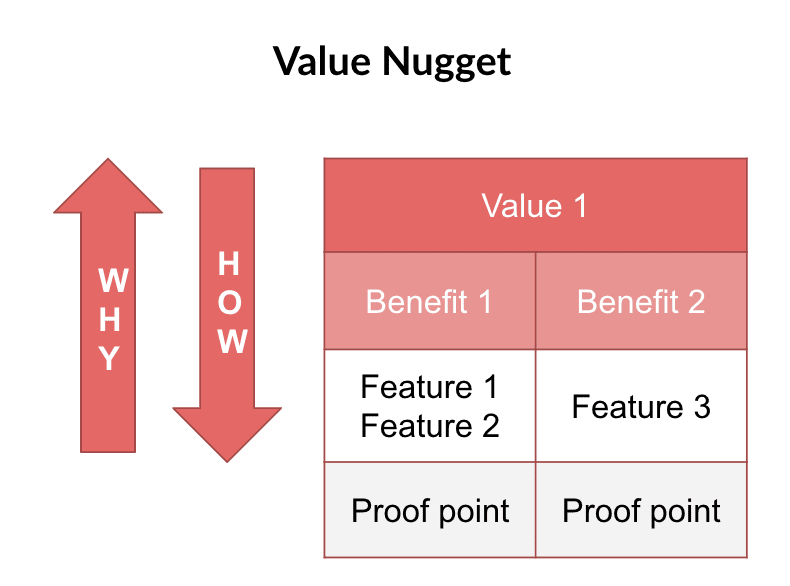
I call this a value nugget.
A value nugget is a way to package up your product features and benefits, while providing a clear hierarchy to navigate effortlessly in sales conversations and marketing.
A value nugget is comprised of:
A value: an attribute or state that the buyer hopes to attain…
One or more benefits: the advantage a buyer gets when using your product.…
Benefits are gained via features: a specific piece of functionality that’s used by your customer…
Benefits are justified through proof: stats or testimonials that can be highlighted to provide social proof, additional context, and evidence that it works…
You can move through the value nugget by asking ‘why’ and ‘how’. This makes it easier to train a narrative and talk track that can be navigated in real-time.
When using this, keep in mind that your value is probably not an immediate outcome of your product, but rather a second-order impact.
An example I’ve written about before is Xerox. When marketing their printers, they used stats that showed that the impact their products had on school learning and education outcomes - not just how fast their printers were.
How to create proof points
Sometimes, you’ll have stats ready to hand that you can already slot into your marketing. Other times, you’ll have to create them.
A good practice - if it works for your sales process - is to ask prospects for stats during the sales process. Not only can these be used to build a business case and provide fodder for Customer Success engagements and renewal conversations, but you can use them to determine the impact your product has after 3, 6, 9, 12 months of use.
You can ask customers for hard stats like conversion rates, revenue, or volumes. But you can also ask for softer stats that are less scientific, but potentially more meaningful: how many hours they think they spent on tasks, how happier their team are, etc.
Collect these in the sales process, ask successful customers how those numbers have changed - and build from there.
The survey approach
This is something that I noticed a company do before and I love it. It’s not the most scientific, but it does help you create a pool of stats that you can use that tie directly to the impacts your customers are hoping for.
Survey your customers with questions like these:
Do you agree or disagree with this statement? [Product] has helped our business to [increase revenue].
By what percentage do you think [revenue would have increased] WITHOUT [product]?
By what percentage do you think [revenue has increased] WITH [product]?
This approach gets you three great stats:
“72% of customers say [product] increased revenue”
“Customers say they grew revenue 4x faster with [product]”
“Customers report X% revenue growth with [product]”
And in most cases, what your customers ‘think’ your impact has been is potentially more valuable than what it actually was.
“What if our numbers aren’t great?”
If the statistics that matter aren’t great, I have four options.
Consider if they are really the best metrics to use
Start a cross-functional project determined to improve that number
Find other stats that may contribute to the intended outcome but are not directly linked
Be honest: “Right now we have X% impact, and we’re dedicated to improving this all the time”
Never lie about stats - always have a doc ready to go that shows the source and calculations if anyone asks, particularly in countries like the UK where the Advertising Standards Authority can ask for proof of claims.
Use proof points to build momentum
Proof points are crucial to show you have real impact on metrics that your customers care about.
Don’t just throw anything down on the website - take the time to consider what stats your customers want to improve, and then find the statistics that will help you get in the consideration set and move the deal forward.
Avoid caveated messaging - be clear, simple, and direct. Honest, upfront messaging is alway the best policy.
How are you using proof points in your marketing? Leave a comment and share your thoughts: