


👋 Hi, I’m James. I write Building Momentum to help you accelerate B2B SaaS growth through product marketing, GTM strategy, sales, and marketing.
Before we get into it, this post is half tongue-in-cheek… and half real. This is a joke, except for the parts that aren’t.
The tides are turning. Product launches are not really about driving commercial outcomes anymore.
Nope. Product launches are performative performances.
Founders, CEOs, and tech tastemakers in the SF/YC bubble now have higher expectations for what ‘good’ looks like when introducing a new product to the world.
Launches are less about what the product does on day one, and more what it says about the people behind it.
9 rules of the cool product launch playbook
If it’s not AI, it’s not worth it
It’s fine if the product isn’t meaningfully powered by AI, you just gotta find a way to tie it in.
AI-native works. ‘Agentic’ even better. Throw in some LLM, RAG, vector-database and you’re golden.
Ambiguity on exactly how it works is fine, because you’ll figure it out later.
AI is less of a capability, and more a costume to signal relevance, ambition, and tech chops. The goal is to be associated with AI, not actually AI - it’s easier this way!
Manufacture intimacy
You know what every prospect in your industry wants? To really vibe with the people behind the product.
And luckily, since both you and them just have click-mouse-send-email jobs, you’re halfway there!
You need to:
Record a podcast and get the video too - I mean, record a video that looks like a podcast. Nothing says ‘I’m cool, trust me’ like a guy behind a mic!
Capture the ‘behind the scenes’ B-roll footage. You’re at a desk scrolling through a dashboard, or pacing in the city on a walking 121… or if you’re ever in doubt, the classic ‘pondering at a whiteboard covered in post-it notes’
Tweet secret, random thoughts that are fleetingly intellectual, but disintegrate under scrutiny. Luckily, X only shows your posts to 2% of your followers, so the veil never lifts.
Get a LinkedIn ghostwriter. You’re too important to write your own posts. Also, you don’t have anything real to say, so outsourcing is efficient.
Intimacy creates an impression of access. You’re not being marketed to! You’re being let in to the secret club of the rich, famous, and ambitious.
You, an ‘insert job title here’ making $100k a year, can really connect with the life of a $2bn startup founder who took more out in secondaries than you’ll make in a lifetime.
Cinema over comprehension
Clear demos answer questions - but who wants that?
You need to create desire, and nothing does that better than a cinematic product launch video film.
Moody b-roll, slow pans, music that suggests importance. Glimpses of the product, but the focus is on people using the product.
Bonus: you don’t need to commit to anything technical that invites scrutiny! Cinema invites projection - viewers fill the gaps with their own assumptions.
Every Series A small feature launch comes with an Apple-style production, complete with viewing party.
Brand it like it’s 1992
Nothing says ‘cool’ like subversion. We’re at the cutting edge of AI! So obviously, branding must look like Windows 3.1 when computer software came on floppy disks.
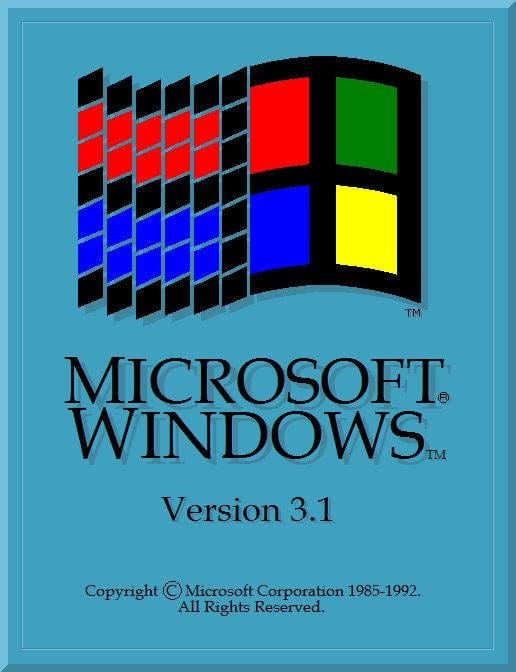
There’s no particular reason for this - it just looks cool. SaaS branding, like fashion, is cyclical.
Speak fluent internet
Language evolves and signals belonging, so you've gotta get onboard with the dominant paradigm.
Are you cooking?
Is your team cracked?
Do you have enough alpha?
Is this feature signal?
Are you locked in or NGMI?
Welcome to the post-clarity era. Use the right language to signal something - sounding right to the right audience matters more than being understood by everything.
Lock in, in public
You’re not committed unless you’re telling people about it!
996, but that’s just about being at an office - you still have food, gym, sauna and massage services, dry cleaning, etc that you can use whenever. But so long as your butt is in the office, you’re good.
And you gotta tell people about it too.
Take photos of engineers at their desks at 10pm. Share your pride on the whole team working on a Saturday - shoutout to Bob who missed his child’s birth to watch Cursor generate a ‘remember me’ checkbox for the login screen!
We hope that old adage is true: an object in motion [or at least, appears to be] stays in motion - enough to get to the next round anyway.
Only personal social is cool
Emails are the most effective form of marketing? Who cares!
Personal social is the coolest. Everyone can be an influencer - or at least look like it.
Make clips of every fake-podcast video. Thot-leadership threads on X that connect something Elon said to your finance platform feature.
Don’t forget to include ‘must engage with every exec-team LinkedIn post’ part of your employee contracts too.
If a product launches and it isn’t ‘big’ on social, was it successful? Probably not.
Optimize for tastemakers, not customers
Customers are generally a bit slow to recognize greatness. Mid-market and enterprise sales cycles take months - far too long to show traction.
Instead, let’s show traction by getting nods from the right people - VCs, friendly founders who happen to be in the same YC group, a comment from that thought leader you gave 2% equity to for association…
Their participation gives you distribution, a sense that something cool is happening, and cultural weight.
Actual customers can come later, validation from peers with vested interests can be instant!
Success = approval
Anyone can make a dollar on the internet, but only a lucky few can get a ‘looks dope’ retweet from a guy with a black-and-white profile picture and ambiguous bio.
Adoption, revenue, retention… they all still matter, but they’re allowed to lag.
The launch is successful if it looked right, sounds right, and land with the right crowd.
Jokes aside… this playbook works
While I’ve taken a lot of creative license with the above, this playbook isn’t stupid - it’s just a reaction to the current environment.
Attention compounds fast. Social proof travels quickly. Public approval is a targeted shortcut to positioning - you’ve just gotta be seen as being good.
The playbook works because many AI startups are looking to:
Raise their next round
Attract talent
Stay culturally relevant in a crowded, hyped space
… and the tactics above work because you’re not selling hard software, you’re selling belief in a team, in an idea, in the future.
… until it doesn’t
The problems will show up later.
Prospects aren’t quite convinced on the product value
Customers churn because they struggle to adopt in their day-to-day
The product, with all the locked-in, cracked engineers you can hire, doesn’t neatly solve a real problem
The fleeting launch moment dissolves and you need a repeatable MQLs > SQLs > Opps > CW pipeline
At some point, belief runs out and reality hits hard.
The least cool launches are often the most effective. They:
Explain the problem plainly
Show the product clearly
Target and reach a narrow audience
Make explicit tradeoffs
Accept that some people won’t care, but the ones who will are going to give you $
Might not pop on X, but will lead to CW sales conversations
None of this is a moral argument.
You can do the cool launch… and you may ‘win’ doing it. Just be honest about what you’re optimizing for.
If your launch is designed to impress the industry, don’t be surprised when you struggle to convert customers. If your business is loud about prioritizing sales, don’t be surprised when a behind-the-scenes X thread isn’t the main launch tactic.
Cool is a choice, so are the consequences. Make the decision!
Sponsored by me
Most product launches fail before they leave the building. Wrong story, wrong channel, wrong timing — or all three.
The GTM Playbook has a dedicated module on launch strategy: how to build the narrative, sequence the channels, and give sales what they need before the date goes in the calendar.
If you’re launching something this quarter, run through it first: gtmplaybook.co