


👋 Hi, I’m James. I write Building Momentum to help you accelerate B2B SaaS growth through product marketing, GTM strategy, sales, and marketing.
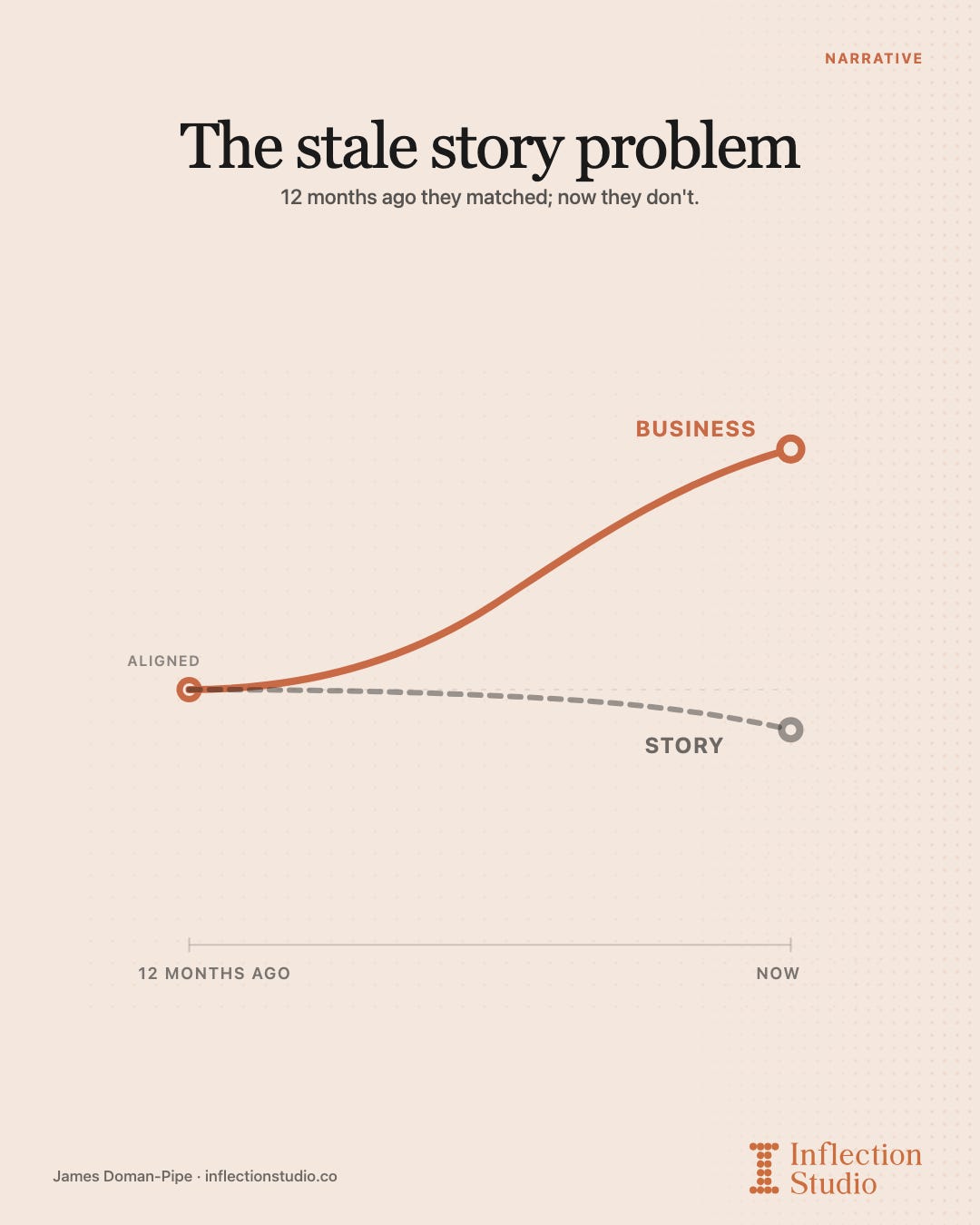
I was on a call last week with a founder whose product has evolved significantly in the past year. They’re chasing a new market with an ICP they think is more likely to close faster. They’ve gained a lot of happy customers and proof points since. All-in-all, they have a genuinely stronger offering than when they launched.
But their homepage still sells the company they were a year ago.
It’s not wrong… it’s still accurate, technically. But it embodies the proposition for version of their business that no longer exists.
It just wasn’t the focus anymore.
The problem that doesn’t announce itself
Obviously, they weren’t happy with the website or their marketing performance. But they didn’t really consider how much of a problem it actually was.
Nobody sends an email saying your narrative isn’t right anymore.Nobody in a meeting (except a product marketer) says “there’s a gap - the website needs to update significantly.”
You just notice all these small, more annoying symptoms:
Pipeline is soft
Sales calls take ten minutes of translation before the real conversation starts
Prospects even say ‘I don’t understand what you do’
Launches create satisfactory noise, but not much real impact
Marketing ships stuff, but the commercial result feels flat
So you try to fix the symptoms, not the underlying cause. What happens?
Teams react in a reasonable way, by adding more activity.
More content
More outbound
More paid
More campaigns
More reporting
… and ultimately, more meetings to discuss why ‘more’ isn’t working
It’s soooo common, but so dangerous to get into a ‘just do more’ loop.
If the underlying story is stale, you’re always behind. Every conversation and every activity gets further away from where it needs to be, because you’re stuck in the past.
I used to think this was mostly a copy problem. If you spend long enough in product marketing you might start to believe that if you just find the right words, everything fixes itself!
Unfortunately not. Bad copy is just a visible symptom, but the real issue is that you’ve moved on, you just haven’t realised, activated, committed to it yet.
The risk is real though… this gap ultimately leads to people getting fired for under-performance. If the launch didn’t land, fire the person who did the launch. If the sales pitch doesn’t go well, fire the sales rep. If the website isn’t effective, if performance marketing isn’t efficient, if products aren’t making money… well, you end up building a whole new team over time.
Where stale stories show up
You can spot these in a few places.
The homepage
The homepage hero was probably true when it was written, and that’s what makes this tricky. It isn’t nonsense. It’s just old. So a good company ends up sounding flatter, safer, and less relevant than it really is.
The sales deck
This often lags even further behind. New slides gets added, a proof point gets refreshed, some product screenshots get swapped out, but the real narrative spine of the story stays stuck in the past.
Launch narratives
I’ve written before about how most feature launches don’t land, and this is one reason why.
You can’t keep dropping new products, new features, and new proof points into an old story and expect the market to figure it out because they just won’t. You’re asking buyers to build a narrative in their own head on your behalf and honestly, they don’t care that much.
Internal language
This is a big part that people miss.
Listen to the founder, then the PMM lead, then sales, then customer success… and I guarantee, everyone is describing slightly different companies.
The business has changed fast, without real consideration, enablement, and change management… so every team compensates in their own way.
This doesn’t just impact day-to-day, but means everyone rows in slightly different directions.
As an unexpected impact, it also stunts recruiting efforts too. If your narrative isn’t about the bleeding edge that resonates with the market and signals your direction and POV, you’re not going to hire the best people who are at the forefront of the industry. You’re not going to excite an innovator with an out-of-date narrative.
What to do about it
Please don’t do a full rebrand!
Don’t hire a brand agency for a a six-week internal philosophy exercise - “If the business was an animal, would it roar or squeek?”
You also can’t ‘iterate by committee’ with 47 comments on a Figma wireframe. - Although I’ve seen that happen and yes, it’s exactly as productive as it sounds.
You start by getting honest about whether the market is hearing the company you’ve become, or if they’re still seeing the company you used to be.
Pull up your homepage and ask:
Does this describe the company we are now, not six months ago?
Does the headline name a real commercial wedge, or are we hiding inside category?
Do the proof points support today’s story, or last year’s?
Then do the same with your deck, then your last launch.
If those assets sound like three different companies, your problem is story, consistency, alignment, and decisions.
Pouring more demand activity into this situation is common, but the wrong anaswer. It’s like stepping harder on the gas pedal, but your wheels are misaligned… you’ll move. It’ll just be messier, more expensive, and harder than it needs to be.
When to evaluate your story
Most companies only revisit their positioning when something is failing: reactive, not deliberate. A rebrand, a pivot, a new funding round, a competitive threat, etc.
Here’s what I’d recommend instead.
Every 6 months: make a new bet
This is the cadence for a proper story review.
Pull up the homepage, deck, key launch assets, and internal language
Compare them against where the business actually is now. Has the buyer changed? Has the market moved? Has the product evolved past the story?
If yes, this is the moment to rewrite, not just refresh.
A new bet means new narrative direction.
Every 3 months: iterate
This is the lighter touch; not a full rewrite, but a deliberate check.
Are the proof points still current?
Does the homepage still reflect the strongest pitch that works?
Are sales still adding their own translation layer on calls?
If things have drifted, tighten with small corrections that improve, stop drift, and have more proven signals in recent performance
This cadence is important.
A 6-month bet is strategic: it’s asking “are we telling the right story?”
Iterating every quarter inbetween is operational: g “is the story we’ve got still landing clean?”
However… most companies will just write the story once, launch it, and hope it stays true.
Trust me, it won’t. The business moves too fast for that. (And if the business doesn’t move fast, it’s ngmi in today’s environment.)
One uncomfortable question
Take your homepage, your sales deck, and your last launch asset. Put them side by side. Read them like a buyer would, not like the team that made them.
Then ask: do these sound like the company we want to be?
If not, stop adding activity and please… fix the story first.