


👋 Hi, I’m James. I write Building Momentum to help you accelerate B2B SaaS growth through product marketing, GTM strategy, sales, and marketing.
Are you an ambitious product marketer: but want to get the tools, skills, and confidence to accelerate your career?
Join us for the next live cohort of GTM Playbook starting May 7th.

Sometimes, I hear about product marketing work that is entirely divorced from the reality of sales.
The narrative sounds good, the deck looks polished, and the enablement gets delivered…. but when you listen to real sales calls, you realize how little of it is helping sellers do the job in front of them.
That’s where frameworks like MEDDPICC become useful.
You don’t need to become a sales manager, but you do need to understand how sellers actually sell, what information matters, and what has to happen for a deal to close.
Your sales assets, campaigns, and positioning/narrative needs to be structured so that it helps your business (both through marketing, sales, and customer success touchpoints) to capture the right information, recognize buying intent, push on the right things, and move the deal forward
And a lot of product marketing assets leave sellers underprepared for real buying dynamics.
The problem is not just messaging quality
A lot of PMM work gets judged on whether the story is clear, but that’s too shallow and where your potential impact gets stunted.
The better test is whether the story helps a seller run a better deal.
Can they use it to sharpen pain?
Can they use it to understand what matters in the account?
Can they use it to uncover process, urgency, timeline, stakeholders, paper process, and all the boring-but-critical things that actually make the close happen?
That’s where a lot of product marketing falls down. Too much of it is still built as if the job ends once the deck and one-pager and training is finalized.
It doesn’t.
If your positioning, narrative, and enablement aren’t helping sellers in a deal, then your work is unfinished.
Deals aren’t won on vibes: sales is a process
Out of all the potential frameworks out there, I think product marketers should care about MEDDPICC. It’s the one I have most experience with, but it’s also the most structured. There are many variations out there, and your business might be using a different methodology - but regardless, the principles are the same.
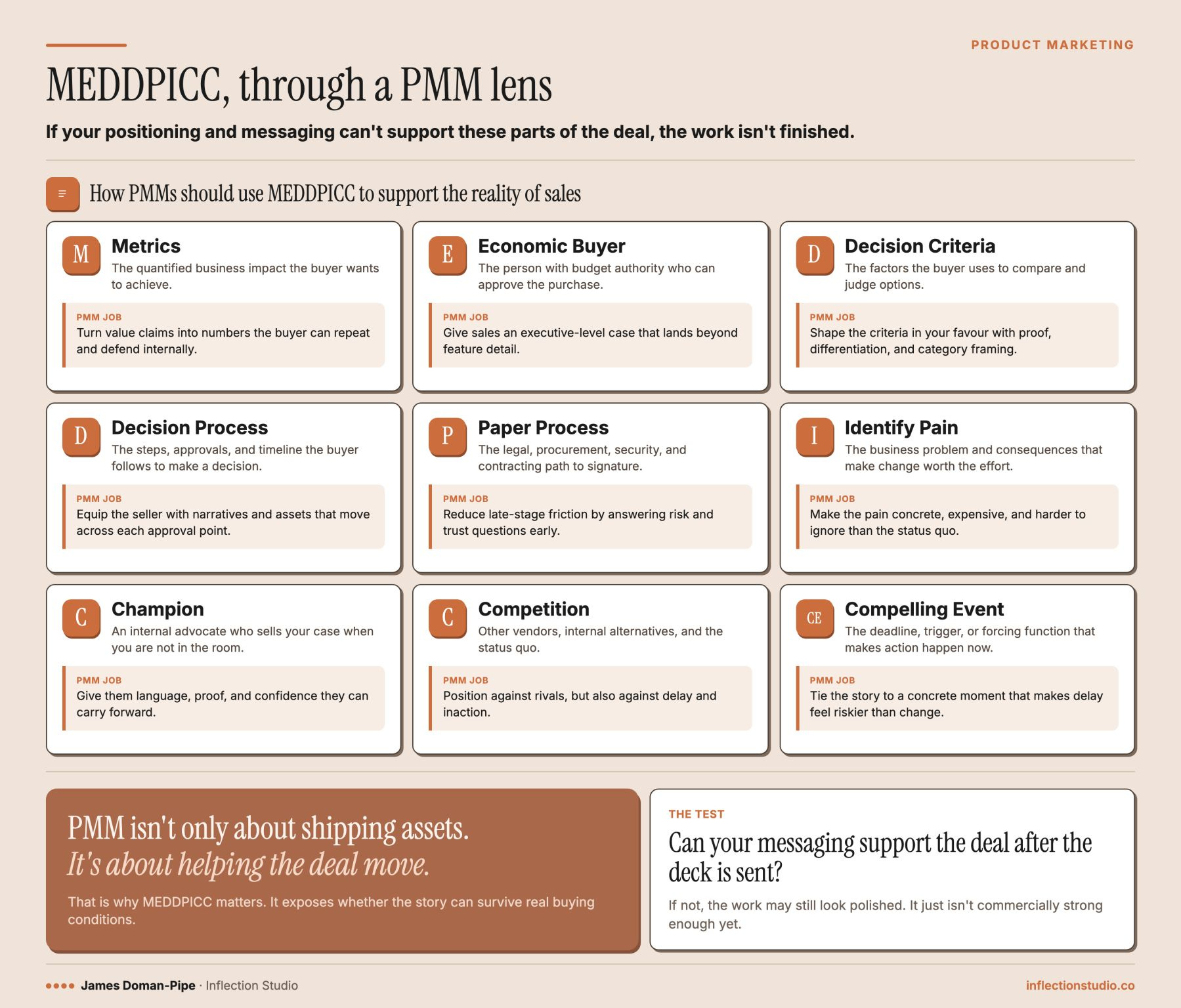
MEDDPICC forces you to think about how buying actually happens, and how selling actually happens too - not just the fluffy, ideal version, but the reality where:
interest is fragile
intent is easy to miss
process and timeline matter
legal and procurement can kill momentum
a champion has to sell internally
These aren’t only sales problems - these are strategic product marketing territory too.
MEDDPICC is a way of understanding what sellers need to learn, capture, and push on if they want to drive a buying process forward.
Metrics
Can the seller help the buyer quantify the problem? Can they turn “this is annoying” into “this is costing us real money, time, risk, or opportunity”?
A lot of PMM work still lives in soft benefit language: save time, improve productivity, drive efficiency.
They’re easy to write… but weak in a deal, and don’t hold up to scrutiny.
Economic buyer
Does your story survive when it moves from user-level interest to budget-level scrutiny? A lot of messaging works with practitioners and gets thinner as seniority rises. That usually means you’ve built a local case, not a business case.
Decision criteria
Are you helping sellers shape what the buyer compares, or are you leaving that to competitors, procurement, and whatever assumptions already exist in the account? Because if the criteria harden around the wrong things, you are already behind.
Decision process
Do your sellers know how buying actually happens? Who signs off? What slows things down? What triggers legal? What needs to be true for the buyer to move this now, not later?
If PMM ignores that, it’s ignoring how deals close.
Paper process
Paper, pricing, security, procurement, legal friction … these things make or break close velocity. If your materials make these moments harder, you are contributing to the drag.
Identify pain
Interest is not enough. Pain has to be sharp enough to force action.
If the seller can’t build urgency and the buyer can’t justify change, the deal drifts. Again, not only a seller issue. A positioning issue too.
Champion
Can someone inside the account repeat the case when you aren’t there? If not, the message isn’t portable enough.
Champions need more than a nice tagline. They need language, proof, and a case they can take into internal conversations.
Competition
Yes, competitors matter. But in a lot of B2B deals, the bigger threat is inertia.
Do nothing
Push it to next quarter
Patch around it internally
Keep using the current process for another quarter
If your story cannot beat that, the rest of the differentiation work is not doing enough.
Compelling event
Some teams add an extra C, for compelling events.
Pain on its own rarely moves a deal. Most buyers can live with pain for months, leaving nothing to force a decision now.
A compelling event is the thing that turns a known problem into an active priority, like a renewal, a board mandate, a product launch, a budget cycle, or a compliance deadline. Ultimately, it’s something that creates a consequence against the status quo.
If the seller can’t uncover that event, or PMM hasn’t built messaging and a GTM motion that captures it, the deal drifts into “later”… which can quickly become “never”.
Where PMMs kid themselves
You might kid yourself that you’re “only a marketer”.
But if you want to really drive and shape go-to-market, you need to be sales strategist too. Not a quota carrier or pseudo-AE, but someone who understands how deals move, what sellers need to learn, which signals matter, where momentum is usually lost, and what gives both the seller and the buyer confidence.
If you don’t understand those things, you’ll keep producing work that sounds right and underperforms in the field. And then everyone will blame sales.
Sometimes that’s fair… but a lot of the time, it isn’t.
What can you do about it?
1. Sit in on real deals
Listen to real sales calls (a lot of them)
Watch where sellers get stuck and where buyers lean in… and you’ll quickly see where process questions appear, and where deals start to drift.
2. Learn the sales framework your business uses
MEDDPICC, MEDDIC, whatever: the acronym isn’t important.
What matters is understanding what your sellers are trying to learn through their conversations, and why it matters to progressing the deal.
If you don’t understand the operating model of the sales team, your enablement will always be a little too detached from their reality… and undoubtedly lead to poor adoption = poor impact.
3. Build enablement for the decision, not the narrative
Your job as a product marketer doesn’t stop at the positioning, messaging, and surface-level enablement.
Build tools and materials and training that help sellers quantify pain, clarify process, map stakeholders, test urgency, handle paper process, and move toward the close with more confidence.
Build buyer-facing assets or marketing/sales initiatives that help frame pain, influence their buying journey, set the scene for stakeholders, create urgency, minimize process, and drive their decision.
That is the work that has impact, rather than just building artifacts for their own sake.
If you want impact in PMM, learn how deals move
Product marketers should care about MEDDPICC because it’s one of the clearest reminders that while yes, sales is a skill, it’s also a process that has to be set, managed, supported, and executed.
Deals close when sellers know how to use a story that resonates to uncover intent, shape the buying process, and keep momentum alive. If you’re detached from that reality, you leave sellers underprepared.
If you’re a PMM, sit in on five real deals this month and inspect them through the lens of whatever sales framework your team uses. You’ll learn more about whether your work is helping deals close than you will from another internal messaging review.