


👋 Hi, I’m James. I write Building Momentum to help you accelerate B2B SaaS growth through product marketing, GTM strategy, sales, and marketing.

Before the first question came in, Alicia and I spent time unpacking the reality of the role today: why it feels stretched, why priorities blur, and why product marketers often find themselves doing everything… except the work that matters.
PMM today feels like being asked to be everywhere at once.
Commercial thinking. Customer understanding. Product depth. Data fluency. AI. Segmentation. Launches. Pricing. Positioning…. all while fielding daily reactive asks (or demands!).
Expectations keep expanding… but your authority hasn’t.
You don’t own the roadmap. You don’t own a commercial target. You influence without levers. You experience a ton of pressure, without direct control.
And because of this, most PMMs get pulled toward the visible, fast-moving part of the job: the top of the pyramid.
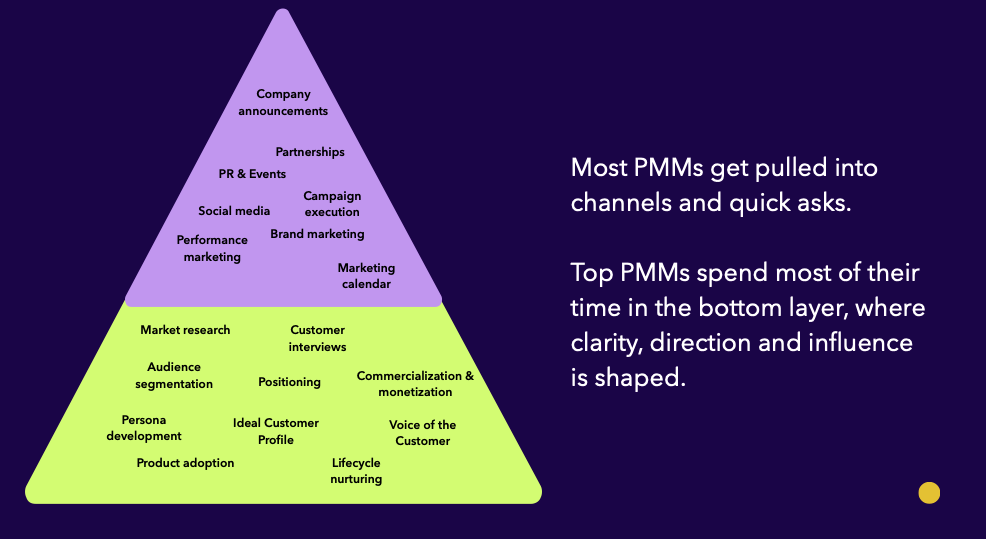
Work that looks productive… but rarely increases influence.
Top PMMs spend most of their time in the bottom layer, where clarity, direction, and influence are shaped.
If you can spend more time there, then everything above it becomes easier, clearer, and more impactful.
We then broke down the three things top-performing PMMs do differently - keep reading to find out more, plus get the exclusive Q&A rundown.
But first, did you know that I run The GTM Playbook course together with Alicia?
The GTM Playbook
Much of the work we shared in the session comes from building and scaling PMM functions inside high-growth SaaS companies.
We’ve taken teams from zero to hundreds of millions in ARR… and seen what breaks when customer understanding, positioning, and GTM foundations aren’t in place.
We like to say The GTM Playbook is grounded in our trauma 🙈
It exists because we lived the failed launches, the restructures, the narrative gaps, and the cost of misalignment across product, sales, and marketing.
That’s why we rebuilt a clearer operating system for PMMs: The GTM Playbook.
We cover six key modules so you can be strategic, execute effectively, and adapt with agility:
Understand GTM fundamentals
Know your customer deeply to win
Define your value proposition
Communicate so people get it
Get your product to market with ease
Iterate to success without losing pace
With 35+ hours of learning, 10+ templates, and peer-led community, it’s the most human way to get the tools, skills, and confidence you need to excel in product marketing.
Plus, it works: it’s 100% five-star rated, and nearly half of past students were promoted within six months.
And, if you need to get your manager’s approval to expense it, there’s a simple template at gtmplaybook.co/boss.
Now, back to the main content:
1. They focus on business impact
We all know that output isn’t the same as impact, but it’s hard to prove.
The PMMs who move up fastest begin by asking a different question: what is the business trying to achieve, and which work helps move that lever?
When you anchor to a commercial outcome like activation, conversion, retention, sales velocity, ACV (or, whatever trendy metric your CEO cares about…) your priorities change accordingly.
You stop reacting, and start shaping. The job becomes clearer the moment you:
Start from impact, not deliverables
Evaluate requests by the lever they support
Use business outcomes to frame your recommendations
Make it visible how PMM work changes a number
2. They lead and weave with evidence
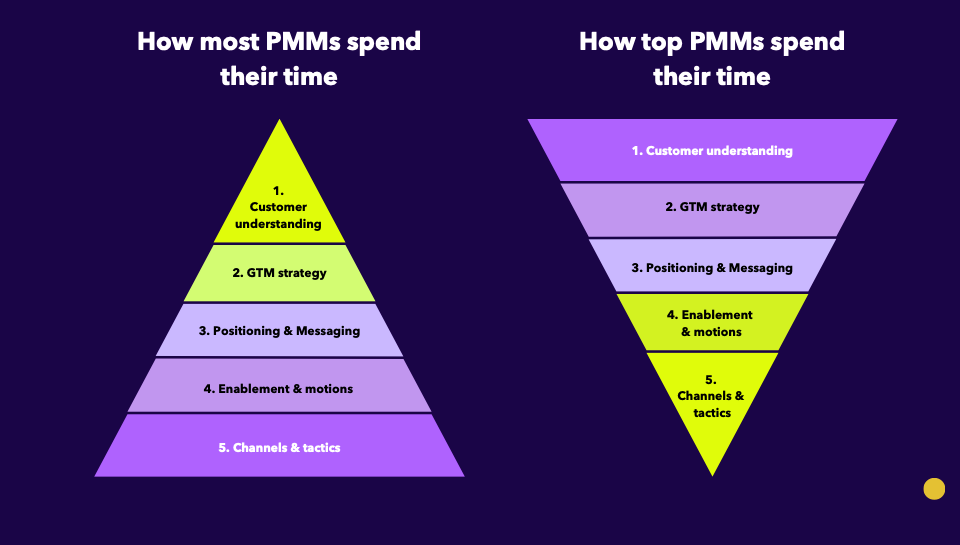
Most PMMs spend their time primarily working on channels and tactics, maybe on enablement and motions, with maybe some targeted customer research later on.
Top PMMs flip the pyramid.
They spend a disproportionate amount of time speaking to buyers, joining sales calls, listening to lost deals, and observing how prospects think about risk, value, and switching.
This enables them to influence and guide GTM strategy
To create more resonant positioning and messaging
To enable sales and commercial teams on the right motions
To execute campaigns and marketing tactics that are going to win.
Alicia described it this way in the session:
You cannot represent the customer in the room if you haven’t heard them in the real world.
Evidence becomes the raw material for influence.
And high-performing PMMs don’t just gather insights, they weave it across their work into:
Positioning decisions
Product conversations
Sales narratives
Pricing rationales
Executive direction
This is also why “insight” in isolation isn’t enough. You need insight → interpretation → implications → recommended action.
3. They build systems that create natural influence
The third behaviour we walked through before the AMA is bringing order to confusion.
Influence doesn’t come from owning decisions… it comes from making decisions easier for others.
Most PMMs create far more documentation than they need, and much of it goes unread. The mental tax of interpreting it is too high for busy teams.
High-performing PMMs build embedded systems that become second-nature across the business:
A repeatable structure for value (Value → Benefits → Features → Proof)
A simple path through positioning decisions
A predictable launch rhythm
Updated sales narratives that reflect market reality
Consistent language that reduces internal friction
This is not about being process-driven; it’s removing friction so other teams can execute more clearly.
Product marketers should not hand people concepts they have to work hard to interpret. Your job is to lower the cognitive load, not increase it.
Balancing foundations with tactics
Then the question every PMM wrestles with: How do you balance foundation with execution?
The honest answer is that PMMs always have to spend time in channels and tactics. Slides will always be needed. Requests will still come your way. Campaigns will still need support.
But top PMMs flip the pyramid:
They earn the right to be in foundational discussions.
They invest early in customer understanding.
They build positioning with evidence, not assumptions.
And because their foundations are clear, their execution becomes faster and more consistent.
When you spend 70% of your thinking in the core foundations, the 30% you spend in execution becomes more effective.
You’re not tweaking slides anymore! You’re reinforcing a story grounded in market truths.
Cementing your reputation as a strategic doer
Top PMMs earn influence through a loop:
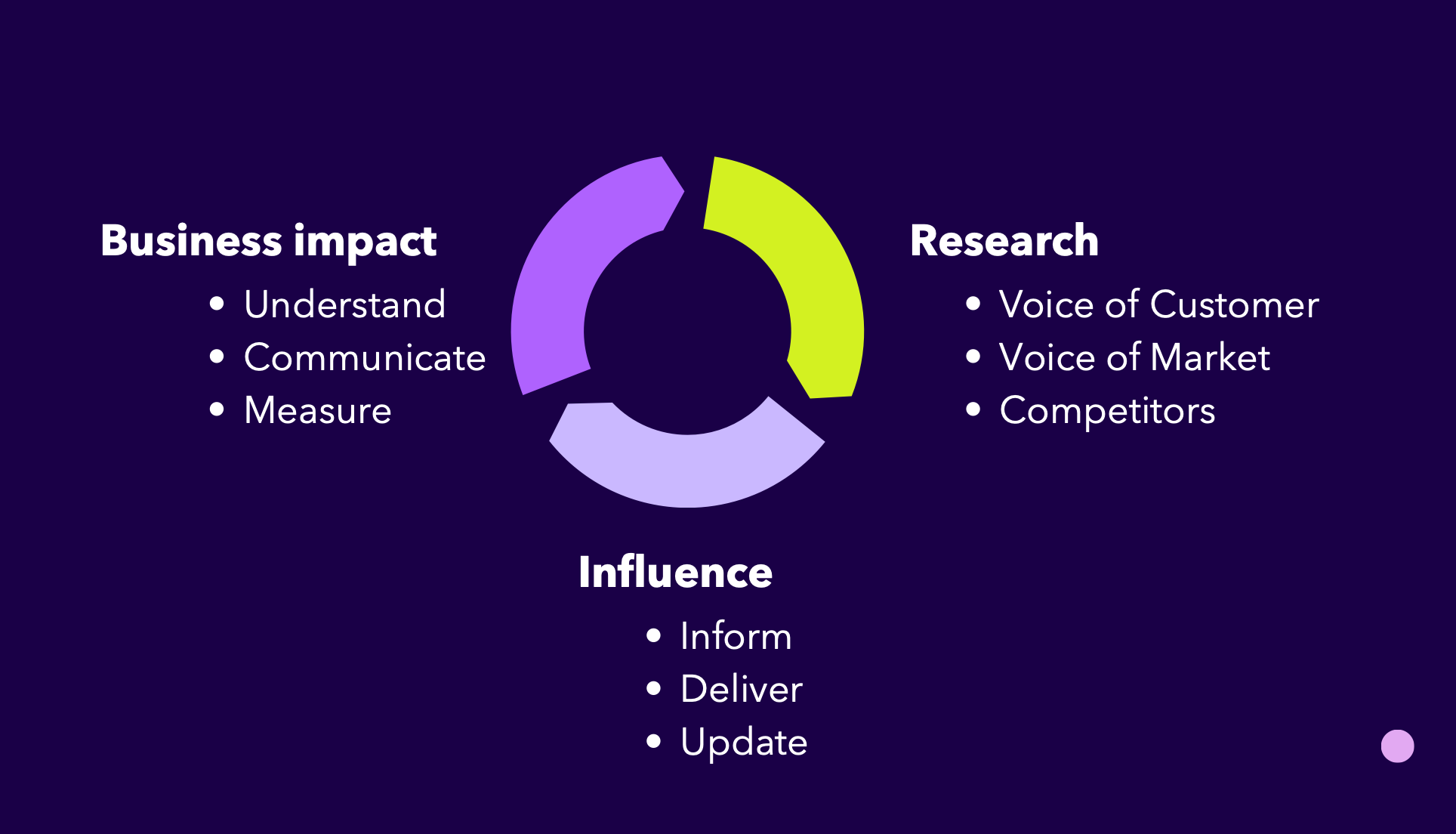
Focus on business impact
Understand the situation
Communicate challenges and opportunities
Measure the impact of your work
Gather evidence and inputs:
Customers, competitors, market signals, etc.
Influence across the business:
Inform the right people
Deliver the right projects
Make updates to business-as-usual material and systems
Repeat…
Run this loop consistently and you build a reputation for clarity, direction, judgement, and operational follow-through.
Earning trust by bringing order
PMMs earn trust when they make complexity simpler for others… not when they produce more work.
Teams shouldn’t have to “do the hard work” just to understand PMM output. The role adds the most value when PMMs take scattered inputs and turn them into a clearer direction with
Less documentation
More clarity
Fewer bespoke assets
More reusable models
Less noise
More signal
Those systems might be repeatable positioning concepts, launch programs, regular updates and insights, etc… anything that stops teams guessing what PMM means, and instead relying on the structure PMM provides.
AMA Highlights
Q: Apart from strengths in storytelling, analysis, and sales enablement… what will genuinely differentiate PMMs and help them deliver value in 2026?
A: The biggest shift comes from moving beyond functional execution and stepping into the decisions that shape the direction of the business. The PMMs who will stand out in 2026 are the ones who use their vantage point to influence choices earlier in the process.
When PMMs bring this perspective consistently, the role stops being defined by deliverables and becomes a source of direction. For example:
Connecting product and commercial plans to real demand patterns
Shaping the narrative that links the product vision to what buyers want
Grounding pricing and packaging in customer expectations
Surfacing market risks and opportunities before they become urgent
Strategic influence is no longer optional. It’s becoming the differentiator.
Q: “What recommendations do you have for someone who works remotely, not in the same market as their customers, where in-depth calls are harder?”
A: Working in a different region from customers adds friction, but it doesn’t remove the need to build customer instinct. There are tons of approaches that can work well:
Partner with sales or CS to identify “safe” accounts for interviews, such as closed-lost deals or churned customers
Use automated sequences to regularly invite these contacts to short calls, so research time is booked automatically
Make customer conversations a weekly fixture rather than an ad-hoc task
The goal is a pipeline of predictable, low-friction sources of insight - not just waiting for the right conversations to magic themselves into existence.
Q: “What’s the most effective way to present customer feedback to product? What loops or channels work best?”
A: Customer feedback needs to be structured, quantified, and linked to business outcomes. You’re going to convince people best with an evidence-based narrative - not just the volume of research itself.
One effective method is a structured “voice of the stakeholder” report that:
Teaches teams how to contribute useful feedback
Aggregates data across markets, deals, or segments
Highlights patterns rather than anecdotes
Links requests to expected commercial impact
When feedback is organised in this way, product teams can distinguish noise from signal… it’s easier to prioritise work because the underlying need is clearer, and the consequences of inaction are more explicit.
Q: “How do you ensure internal docs and one-pagers are actually used by sales?”
A: Enablement only works when it is connected to how sales teams operate. Documents that live in isolation don’t change behaviour. Adoption improves when PMMs approach enablement as a system, not an output.
I’ve taken quite a hardline approach to this before - sales adoption is an accountability issue.
Align with sales leadership so materials are part of onboarding, training, and inspection
Map every collateral request to a stage in the buyer journey
Deprioritise assets that don’t help advance a deal
Check how existing materials are being used before assuming the team needs more
When enablement reflects how deals actually move (and when sales leaders reinforce usage) PMM materials become part of the rhythm of selling rather than static assets in a folder.
Q: “Is the IC career path limiting?”
A: No! In many companies it is expanding, especially as fractional roles become more common. Both IC and manager roles mean PMMs can have meaningful impact. The difference is in how that impact is expressed.
A strong IC can influence strategy, shape positioning, guide product direction, and become the person teams rely on for clarity and judgement. A strong manager enables others to do this at scale. Neither is inherently superior.
The best path is the one that reflects how you like to work:
If you enjoy depth, ownership, and autonomy, the IC route fits
If you enjoy coaching, structure, and team dynamics, management fits
Both create value, and both are viable long-term careers… and neither should be treated like a consolation prize.